New Discussion Group: "Magnifica Humanitas"

Emma Martin • August 25, 2026

Safeguarding the Human Person in the Time of AI
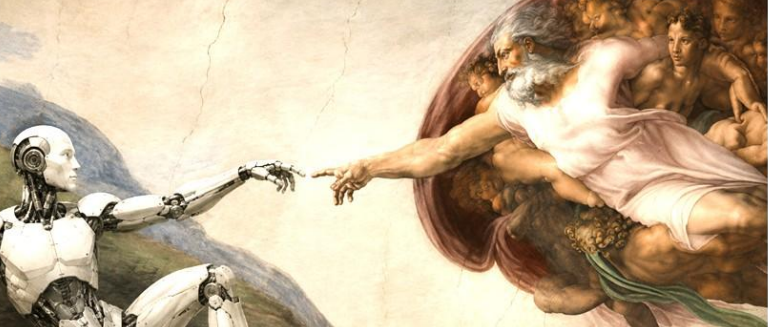
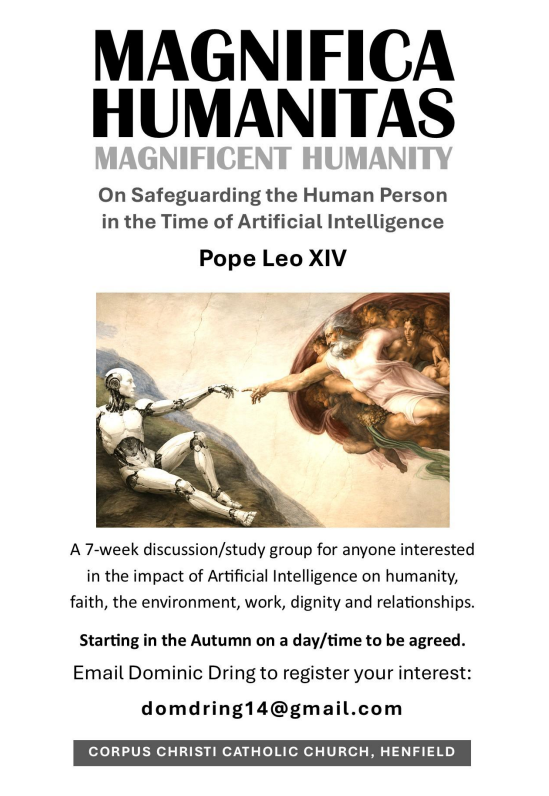
Deacon Dominic Dring is planning to run a seven-week discussion and study group at in Henfield this Autumn exploring Pope Leo XIV's teaching Magnifica Humanitas ("Magnificent Humanity") on artificial intelligence and its impact on humanity. 


The group, to be hosted at Corpus Christi Catholic Church, Henfield, is open to anyone interested in what AI means for faith, work, dignity, relationships and the environment.


No day or time has been fixed yet, Deacon Dominic wants to hear from interested parishioners first, so the sessions can be scheduled at a time that suits the group. Registering your interest doesn't commit you to anything at this stage; it simply helps him gauge numbers and find a slot that works for everyone.


If you'd like to take part, or would simply like more information, please email Deacon Dominic Dring at domdring14@gmail.com.

By Webmaster August 25, 2026
“Silent prayer, a relationship of intimate friendship with God, is the basis for every Christian life.” Fr Marie Eugène of the Child Jesus We gather and follow a gentle rhythm and format: arriving in the hall, upstairs, for refreshments, followed by a short reflection on Silent Prayer in the context of Carmelite Saints. We then move into the church for a time of Silent Prayer. Sessions start at 3.30pm and end around 5pm. We meet on the first Saturday of every month with a break in August. Whether you are new to silent prayer or have been walking this path for some time, you are most welcome to join us.
By Emma Martin August 25, 2026
Parish Knitting Continues to Warm Lives in Ukraine
July 28, 2026
COME AND BE PART OF SOMETHING NEW!
By Emma Martin July 2, 2026
Rector of the Venerable English College in Rome succeeds Archbishop Richard Moth as the Sixth Bishop of Arundel and Brighton.
By Webmaster June 29, 2026
On today’s feast, we celebrate two of the greatest figures of the Church - St Peter, our first pope, the rock upon which Christ builds his Church, and St Paul, the great proclaimer of the Gospel and establisher of so many churches. The fact that both men struggled with significant weakness and had fallen short of the exhortations of the Gospel is a great source of comfort to us. Through their example, we ourselves know that Christ calls us to mission in the midst of our own struggles and brokenness. Moreover, these imperfect men were chosen specifically to demonstrate that the gates of Hell will not prevail against the Church. No matter the times we are in, no matter the weaknesses, difficulties, and yes, sins we encounter in the Church and in ourselves, Christ assures us that the ship will not sink, that all will not be lost, that the Lord will triumph - in fact, He already has! This impresses on us all the more how essential it is that, no matter what our frustrations may be, we must remain in unity with the See of Peter under the Holy Father, not merely in a cold, legalistic way but in a positive affirmation that, amidst it all, we are called to live out our vocations in union with his. At times this can be a bit of a challenge, when we face divisions and difficulties in the Church, and when we know that there are so many Christians whom we love, benefit from and respect who are not in full communion with the See of Peter. But in preaching the beauty of the gift that the Papacy is for the Church, we can hopefully encourage others to also receive that gift and continue to pray for them and walk with them with loving patience. I am particularly mindful of this today, as I go to St Peter’s for the Pallium Mass, in which Archbishop Richard Moth and other recently appointed Archbishops will receive the Pallium from Pope Leo. The Pallium (the word coming from the Latin for ‘mantle’ or ‘cloak’) is an ancient sign of the Pope’s authority, which Archbishops wear to indicate their participation in that authority, and indeed their unity with it. This isn’t something that merely constrains bishops to ‘toe the line’ as one would expect from a secular institution; instead, it is ultimately a gift that leads to a great spiritual freedom, as it means that their authority to bind and loose is the same authority granted to the Apostles in union with Peter, giving them the great confidence that they are indeed appointed by the Church, and therefore sent by God to be a part of His great mission.  Much as I love being back with my brethren at the seminary, it is with a heavy heart that I have left Horsham. I’ll be keeping you all in my prayers as I brave the heat in the Eternal City, and I’ll raise an Aperol Spritz in your honour. God bless you, and happy Solemnity!
By Webmaster June 13, 2026
And proclaim as you go, saying, “The kingdom of heaven is at hand.” Heal the sick, raise the dead, cleanse lepers, cast out demons. Liturgically it has certainly been a rather exciting week. Last Sunday we celebrated the solemnity of Corpus Christi, on Friday the solemnity of the Sacred Heart, and indeed I would be remiss without mentioning the memoria of St Barnabas on Thursday! But as we return to the more regular rhythm of the Church’s liturgical calendar in Ordinary Time, perhaps we can pause to reflect on the message in today’s Gospel that the Apostles preached to the lost children of Israel; The kingdom of heaven is at hand. There are many things that one can say about this passage. We know that the kingdom of God is here and yet is not of this world; that it is to be truly experienced in the next life, and yet also fast approaching, as we await the remaking of all things on the last day. In fact, some people have, out of an attempt to appropriate or control what the kingdom of Heaven is all about, either turned it into something worldly and political, or something merely theoretical and metaphorical, thus losing what it really is, a theological reality. Ultimately, the kingdom of God is intimately tied up with Christ’s coming to us. He has come, and He is here, really, truly, substantially, and yet, He shall come again on the last day, and we are told to wait with our lamps full so that we may joyfully enter the coming wedding feast. How are we to readily anticipate the coming of Christ whilst also being in His presence? How do we wait for Christ, whilst in a sense waiting with Him? One of the most profound ways in which we can do this is Eucharistic adoration. In this time in which the Kingdom of Heaven is at hand, Christ’s Eucharistic presence is indeed giving miraculous healing and cleansing effects to many. In Lourdes, it is significant that it is in fact during the Blessed Sacrament procession that the most people are healed rather than at the grotto or the baths, and so how wonderful it was for us to process with Our Lord in His Eucharistic presence last Sunday, bringing Him to the people in our local community! What better way to proclaim that the kingdom of God is at hand than worshipping Him in our streets!  So let us try to be mindful of Our Lord’s Eucharistic presence, as we spend time with Him in the Blessed Sacrament, and as we receive Him in Holy Communion. Perhaps we can try to spend slightly more time before Him in prayer this week, or perhaps we can try to be especially reverent when receiving Him, and if possible, find an extra moment to be with Him in silence, to allow Him to continue to cleanse and cast out whatever prevents us from being closer to Him in our hearts.
More Posts